Friday, August 28, 2009

Blastocyst vs. Early Embryo Transfer: Pros and Cons

Virtually all physicians who provide assisted reproductive services are highly motivated to optimize IVF success rates. Achievement of this lofty objective is marred by the inability of conventional microscopic grading, to reliably select those embryos that will successfully implant into the uterine lining. This unfortunate reality often prompts IVF practitioners and In Vitro Fertilization clinics to transfer multiple embryos at a time. While such practice indeed does increase IVF pregnancy rates, it comes at a high cost since it all too often results in high order multiple pregnancies (triplets or greater), placing the newborn babies at severe risk of life threatening prematurity-related complications, devastating families and leaving society to foot the bill.

It has long been recognized that as embryos progress developmentally during the first 5-6 days following fertilization, many of those of “poorer quality” succumb along the way. It follows that a much higher percentage of embryos that survive to the fifth or sixth day post-fertilization is likely to be of “good quality” than would be the case by day two or three. IVF researchers applied this principle in an attempt to achieve high pregnancy rates without increasing the risk of high order multiples. They did so by challenging embryos to progress to their most advanced pre-implantation stage of development (i.e. the blastocyst stage) by day five or six post-fertilization and then selecting only one or two such “better quality” embryos for transfer.

The concept of blastocyst transfer (BT) is not new to the field of Assisted Reproduction. In fact, reports of human pregnancies following BT date back to the early 90’s. However the ability to consistently produce a high percentage of blastocysts from cultured embryos is a relatively recent development.

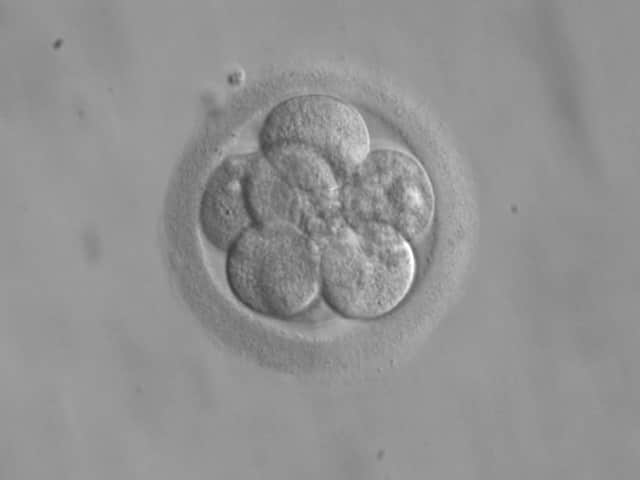
The freshly fertilized egg before it starts to cleave (divide) is called a zygote. After the first 24 hours, (Day 1) the embryo has divided into 2 cells. By Day 2 the embryo has 4 cells (blastomeres) and by the third day, there should be between 6 and 9 cells. Up to that point, embryonic development is under the control of maternal genes in the egg. Around the 8 cell stage the embryo’s own genes (embryonic genome) begin to take over control of development. By the fourth day the embryo has between 16 and 32 cells. At this point it looks like a mulberry and is called a morula. Until the morula stage all the embryo’s cells are the same and are totipotential (i.e. they have the ability to ultimately develop into any tissue or organ type). By day 5 post-fertilization, differentiation of the embryo begins. A fluid-filled cavity (blastocele) forms in the center of the conglomerate of blastomeres. This blastocele will eventually become the amniotic sac and the fluid surrounding the conceptus in the uterus. The cells around the outside of the morula develop into the trophectoderm, which will eventually form the placenta and fetal membranes, while the cells on the inside of the morula aggregate and group together to form the inner cell mass, which ultimately develops into the fetus. This complex creation is now called a blastocyst. As the blastocele fills with fluid, the blastocyst expands, its walls thin out and it eventually breaks through (hatches) its envelopment (zona pellucida). The trophectoderm then begins to invade the uterine lining (implantation) by the 6th to 8th after ovulation or egg retrieval (when IVF is performed).

Human embryos are very fastidious. They have specific metabolic requirements in order to survive. The earliest type of artificial embryo culture media developed for IVF purposes was relatively simple in composition and could only support limited embryonic development in the Petri dish and incubator. Thus, the majority of embryos cultured in such media could only survive to the third day whereupon their development would arrest. Subsequent improvements in media composition allowed for more reliable embryo development to the third day… which became and remained the standard time at which embryos were transferred for more than two decades.

Starting in the mid-1990s, researchers in Australia, Scandinavia and in the USA simultaneously developed a new generation of culture media that can support the growth of embryos to the fifth or sixth day. This development was based on the recognition that the metabolic needs of the early embryo changes as it progresses in development, much in the same way as happens in natural conception as the embryo journeys through the Fallopian tube to the uterus. These so-called “sequential culture systems” are improved embryo culturing methods designed to simulate what happens in the reproductive tract during natural conception. They involve sequentially changing the media environment as embryo development progresses. Approximately 35-40% of “good quality” day-3 embryos (comprising 6-9 cells with minimal/no fragmentation) can be grown to the blastocyst stage using such advanced culturing methods.

It is important to note that in spite of the introduction of specialized sequential culture systems and other new techniques, at best 35-40% of “good quality” embryos develop into blastocysts (even in younger women who produce the best quality eggs). However, since blastocysts are more likely to implant than are day-2 or day-3 “good quality embryos”, the transfer of but a few good quality blastocysts yields better IVF success rates than would be the case following the transfer of a higher quantity of early embryos. Moreover, by transferring fewer blastocysts, the fertility clinic can substantially reduce the risk of high order multiple pregnancies.

The presumption that early embryos would be better off in the uterus than would be the case in an incubator in an IVF laboratory is erroneous. This fact was established conclusively through a study we recently performed and published on in the journal Fertility and Sterility in 2007. This research involved genetically testing each of a large number of eggs sequentially, using comparative genomic hybridization (CGH); first, prior to fertilization, and then twice more in turn (on day 2 and day 3). We then followed each of the resulting embryos in culture to day 5-6 to see if they would develop into blastocysts. The study revealed that a high percentage of the embryos that developed to blastocysts had originated from chromosomally normal (euploid) embryos and were thus “competent” (highly likely to develop into normal babies) while with few exceptions, those that did not develop into blastocysts were almost invariably chromosomally abnormal (aneuploid) and were thus “incompetent”. We concluded that since the uterine environment is no more favorable than the Petri dish in terms of embryo development, there is no advantage in transferring embryos to the uterus earlier than the blastocyst stage.

The use of CGH to select the most competent embryos for transfer, requires that they first be grown to blastocysts whereupon they be cryopreserved (frozen) for days or weeks until the results of CGH testing are available. Thereupon, one or two euploid (“competent”) embryos are transferred to the uterus. This modified application involving CGH selection of the “best” blastocysts to transfer has further enhanced the efficiency of IVF, markedly increased the baby rate per embryo transferred, reduced the miscarriage rate, and minimized the occurrence of chromosomal birth defects.

It is my personal opinion that with few exceptions, blastocyst transfer should be performed preferentially in IVF. Other than convenience and easing pressure on doctor and/or patient, there is in my view seldom any advantage in transferring embryos on day 2 or day 3. After all, we have demonstrated conclusively that embryos failing to survive to the blastocyst stage are almost certainly (aneuploid) “incompetent,” and are thus unable to propagate normal pregnancies anyway.

28 comments:

  1. Is there a threshold number of embryos that you require in order to choose a 5 day transfer, over a 3?

    Does age of patient factor into your decision?

    Thanks!
    ReplyDelete
  2. I prefer blast transfers accross the board. However women with <4, 6-9 cell embryos by day 3 can just as well do day 3 transfers.

    Geoff Sher
    ReplyDelete
  3. Do you feel a blastocyst has a higher propensity to result in a viable pregnancy even if it was a slower growing embryo? For example, would you consider a blastocyst with no fragmentation a good option for transfer, even if it was only 4 cells on day 3? Does the rate of growth affect the viability, or growth rate a non-issue because it made it to blast stage regardless? Thank you for your time!
    ReplyDelete
  4. I am scheduled for an interval transfer, 1 emb on day 3 and 1 emb on day 5. What are your thoughts on this method?
    I had my EC yesterday, as of today 8 eggs fertilized, seven of which are of good quality.
    ReplyDelete
  5. If the embryo makes a good quality blastocyst by day 6 npost-fertilization,regardless of its cleavage on day 3, it has a chance of making a baby.

    I do NOT believe in traversing the cervix twice in one cycle of IVF. The risk of introducing infection is too great. Thus I am against "interval transfers".

    Geoff Sher
    ReplyDelete
  6. Hello!

    I'm a 26 yr old with primary infertility due to my husbands extremely poor sperm count and motility. It's my first IVF w/ICSI cycle and I produced 16 eggs out of which 14 were fertelized. Now it's day 5 and I'm going to have a blastocyst transfer in a few hours..my embriologist is quite optimistic and has told has that we have 4 healthy good blasts available, 1 of them has completed the blastocyst formation and the other 3 shall do so in a few more hours. She suggests we shall transfer all 4 of them..
    Plz can u shed some light about the prospects of implantation in this case and explain why she said the 3 would be completing blastocyst stage in a couple of hours is that okay? Also wat are the chances of multiples I'd love to have twins..finally she told me the remaining 10 fertelized eggs are slow growing if they become glass tomorrow i.e day 6 then they'll inform us and freeze them otherwise they'll be disposed off.. can't they be preserved?

    Thanx in advance!
    ReplyDelete
  7. At 26 I would respectfully suggest no more than 2 blastocysts be transferred. The remainder can be vitrified and banked.

    I agree with your RE that if they are blastulating already (even if they are in the early stage now) they can be transferred and allowed to develop further in the ut6erus.

    Good luck!

    Geoff Sher
    ReplyDelete
  8. Hello again and thanks!

    Well I eventually ended up transferring all 4 as the embryologist had suggested as I'm already willing for multiples..

    What do you suggest are the odds of implantation especially multiples here and could you briefly explain the factors favoring implantation like is it more dependent on patient's age / acceptance capacity of uterus or the egg/blast quality eventually?
    Waiting for 10 more days to have a preg. test seems like a lifetime, any signs of implantation for an early heads up ??

    best regards!
    ReplyDelete
  9. The issue is embryo competence (is it chromosomally normal) and yes that is influenced by age (see applicable articles elsewhere on this blog). The other issue is uterine receptivity as it pertains to lining thickness, absence of surface lesions in the uterine cavity and immunologic integrity7 of the endometrium.

    Good luck!

    Geoff Sher
    ReplyDelete
  10. hi, my wife 35 and i 36 have just retrieve 12 eggs,9 were matured.on day 1,our doctor said 7 were good and today day 2 only 4 still compentent.we will wait for the 4 to reach blastocyct which is 3 more days from now.we're little edgy that none might reach day 5,if this happens why could it be and base on your wide experince is it best to wait for day 5.a little backgrd,the daignose for our infertility was my low sperm count,in day1,5,8,10,12 all bloodtest e2,lh+ultrasound her lining was perfect,all showed well.my wife was on burselne for 2week then fsh 225iu for 12days.is the 12eggs retrieve normal and what would you say a good day 5 quantity for her age?and what the odds in our case that blastocycts produce take home baby.your articles are by far the in the web.thanks
    ReplyDelete
  11. First, embryos that do not make it to blastocyst (day 5-6b post fertilization) are almost always abnormal and would not have been worthy of transfer earlier on, anyway.

    Second, it is not possible to comment further on the stimulation or response without having much more information.

    I suggest that you call 800-780-7437 and set up a free medical telephone consultation with me to discuss in detail. Be sure to forward all medical records in advance thereof.

    Good luck!

    Geoff Sher
    ReplyDelete
  12. hello again doctor sher,
    i made a previous comment and now after more than two week we got a taste of failed ivf.we were able to transfer 3blast but after 1week post transfer my wife had brownish discharge that turn out to her period.together with our doctor with reviewed the cycle and everything was well in the 12 harvest 9 matured 3 reach blast nothing to freeze.my wife confined herself to bed-couch-bed-couch after transfer.is there a way to increase implantation on our 2nd ivf?in your wide experience what could be the reason for failure of ivf after transfering 3blast grade1,grade2,grade1-?
    thanks
    ReplyDelete
  13. I would need a lot more information to comment fully. However, it could be that in spite of appearance microscopically, these blastocysts were actually chromosomally abnormal. That is not uncommon. Read up elsewhere in this blog on "embryo selection" and you will understand better what I mean. It is also possible that the problem lies with implantation. Read up elsewhere on this site, on this as well.

    Feel free to call 800-780-7437 if you wish to discuss.

    Geoff Sher
    ReplyDelete
  14. Hello Dr. Sher,

    This is my first attempt at IVF. I have PCOS and my husband is normal. I'm 32 years old and my husband is 35. I just completed my transfer yesterday and they said I had 2 morula's transferred, on of which was progressing more than the other. I have never heard of a morula and wondered what the odds of conceiving are with a morula? Also will the morula become a blastocyst, if so how soon? Do you know of any literature I could read about this? Thanks so much for your help on this I wasn't given much info on this during my procedure.

    Kindest Regards
    ReplyDelete
  15. DR.Sher

    Im in the process of IVF and im 29 and the reason for ivf is my tubes were closed and i had them open and got a tubel this march so know im doing IVF im on day 5 i had 13 eggs 6 were good 4 fertelized today day 5 they wanted to wait till day 6 cause they were only at 11am at 33 cells but he said that they he was not happy 100% with the quilty off eggs what do you think my chances are of a good day 6 transfer if it was slow and what amount of cells by day 6 if not 100 would you say would be ok for a transfer thanks
    ReplyDelete
  16. It should be an expanded blastocyst by day 6. Hard to say but there is a chance that it could develop to thnat point within 24hrs.

    I will be holding thumbs for you.

    Geoff Sher
    ReplyDelete
  17. Hi there Dr Sher,
    I had 10 eggs collected from one ovary and 7 fertilised, however due to the risk of OHSS , my clinic froze 6 good quality embryos on day 2. I'm just wondering what are the chances of a day 2 frozen embryo reaching blastocyst? Would you advise this or just go with transfer on day 2 once thawed? I believe 2 will be thawed at a time.
    Thanks
    Michelle
    ReplyDelete
  18. Survival of embryos post-thaw, depends on embryo quality, the timing of the freezing and the method of freezing.

    1)Embryo quality is determined by the age of the woman, the method of ovarian stimulation and the lab quality.

    2)With regard to the timing of freezing; I am in favor of early freezing because embryos that do not survive to blastocyst in the lab are almost always abnormal anyway. So who are we kidding by freezing prior to day 5-6 (blastocyst).

    c). The method of freezing is also very important. Ultrarapid freezing by vitrification rather than slow conventional freezing does not harm embryos. Slow freezing does (see the article I wrote on vitrification elsewhere on this site).

    In your case, the dye has already been cast so I would advise thawing the day 2's and transferring those that upon prolonged culturte make it to good quality blastocysts.

    Geoff Sher
    ReplyDelete
  19. Hi, me and hubby are both 31 years old with unexplained infertility... I just had a transfer of a single embryo (in canada its the law to have only one.. My doc said) anyway he sais that it was the only one out of 4 to have made it to early blastocyst stage... I had 17 retrieved 8 mature 4 fertilized ... 4 7 cells at day 2 and now only 1 early blastocyst !!! What are my chances of conceiving??? Is it very bad?? Please help... Thanks
    ReplyDelete
  20. Dear Dr Sher,

    I am a 42 year-old woman with no fertility issues except the intrinsic decrease of fertility (and eggs quality) due to my age, but my spouse (which I met 4 years ago) has a very low sperm count and mobility (he was operated for a varicocele in his mid 30s, and the varicocele is likely to have reformed given the semen analysis - apparently his sperm count is at 5% of the fertility threshold, and if he were to be operated again, it would only increase the sperm count to 15% of the fertility threshold)So the IVF was the only alternative for us to try to have a baby (after 2 years of trying by the natural way and given my ovarian reserve...). I went through a first IVF cycle back in January 2011 and it failed (out of 9 mature eggs that got fertilized after ovarian stimulation and eggs punction, only 2 embryos were relatively "good enough" to be transfered on day 3.) I am now at day 8 after the embryo transfer of my 2nd IVF attempt, waiting for the pregnancy test in 4 days (this time I took DHEA and CoQ10 for 3 months before the IVF cycle, and I also had acupuncture treatments - after the punction of my eggs, out of 10 mature eggs, 6 got fertilized and at day 3, only 3 embryos were good enough to be transfered, with one of very good quality according to the embryologist)In the meantime, not knowing the issue of the procedure, I can't help thinking of my future in case of a failure: I live in Quebec and since August of 2010, the government has been funding IVF treatments (up to 3 cycles), but the fertility clinic where I am treated doesn't proceed with IVF for women that are 43 and older; I am not sure if they do blastocyst transfer. After the failure of my first IVF, my gynecologist had told me that the doctors at the clinic were reluctant about going further in the process with me, given the poor quality of the embryos produced (and because it is the government that pays, the clinic wants to keep the success rate as high as possible), but my gynecologist insisted that I had at least a second attempt, and here I am. Now, in case of a failure of my 2nd IVF, should I try to consult another clinic and ask if it is possible in my case to get embryos that reach the blastocyst stage before the transfer? I don't care about having to pay (money is not an issue). Do you think that something could be done to increase the fertility of my spouse? I thank-you in advance if you take the time to read this message

    Julie
    ReplyDelete
  21. Thank you for this communication.

    First, as this article (above) points out, there is no good reason NOT to allow all embryos to reach blastocyst before being transferred because those that do not make it to blastocyst will almost never develop into a baby, anyway.

    Please read the blog on "varicoceles" and you will note that when the sperm count is low, surgery rarely helps. I see no point in a repeat attempt. This having been said, ICSI can still propagate good embryos.

    Your age is a factor along with your apparent diminished ovarian reserve. However, it is essential to implement a "strategic" protocol of stimulation (see the article: "An Individualized Approach to Ovarian Stimulation for IVF" which I posted on November 22nd on this site for details).

    I advise against taking DHEA because it is a male hormone that metabolizes to testosterone in the ovaries (and elsewhere) . The last thing you need is increased ovarian te3stosterone production.

    I invite you to call 800-780-7437 and set up a free medical telephone consultation with me to discuss.

    Geoff Sher
    ReplyDelete
  22. Dear Dr Sher
    I am 39 year old who had a miscarriage at 10 weeks at age 35 and an ectopic a few months ago. We decided to pursue IVF because of my age, prior loses, and my husband was diagnosed with varicoceles (he is 35 years old) . My initial day 3 IVF testing indicated I had a slightly high FSH at 11.9 and low AMH at .73. I had my first IVF cycle in July where I was given 350 units of Follsitem 2x a day with low dose HCG daily. I started to take Ganerilex on day 5 of stimulation. I had a total of 7 follicles and only 6 grew and I ended up with 4 eggs at retrieval. All 4 fertilized through ICSI (we did because of my husband’s condition. He is due to get a procedure to improve his sperm morphology in November). All 4 made it to day 5 - all with even division of cells with minimal fragmentation. One turned into blast on day 5 (grade 3BB) and the others I was told stop developing at that point. We decided to freeze the one blast and do another cycle since we had meds left and given my poor response. We also wanted to try to get more blasts as we wanted to do genetic testing and wanted a few more embryos to make it cost effective. I am about to start my 2nd cycle on Sept. 16th. This time I am going to be on 450 follistem 2x a day, the low lose HCG and my dr. is also adding cholmide. Do you think I will respond any better on this protocol?
    Also, my doctor is really pushing genetic testing on us because of my age and I am just not sure what to do. If we have another cycle like our first and we only end up with 1 or 2 blasts I may just say transfer one in and hope for the best. I read that if an embryo makes it to blast there is still about a 20% chance its abnormal and that goes up to about 35% for a woman around my age. So in my mind we have about 70% chance or so that the embryo is healthy. Do you agree with those stats? Given my situation with a blast 3BB frozen.. do you think genetic testing is necessary on that one as well as any others I may get of equal or better quality with this round? I would appreciate your insight!
    ReplyDelete
  23. Dear DR Sher I have twice had 4 cells embryos put in from fresh cycles and it failed both times.Is it too early to put in? And is that why both cycles failed?.When should u have them put in?
    ReplyDelete
  24. Dear HARMZ.

    Embryos that by day 3 have failed to attain a 6 cell stage are most likely to be chromosomally abnormal (aneuploid) and are "incompetent".

    Might I recommend that you read the following additional articles on this site which you can access by going to the “home page” where you will find a "search bar" in the upper right hand column. Type in the following subjects into the bar and it will take you to all the relevant articles I posted there.

    1. "An Individualized Approach to Ovarian stimulation" Posted on November 22nd, 2010
    2. “Agonist/Antagonist Conversion Protocol”
    4. “IVF success: Factors that influence outcome”

    When you have read these (and any others that might interest you) might I suggest that you consider calling 800-780-7437 or 702-699-7437 to set up a free telephone consultation with me so we might discuss your case in detail.

    Geoff Sher

    .
    ReplyDelete
  25. Dear HARMZ.

    I am 41, had 2 failed IVF's on my own. I am currently in my 2ww with donor egg (my 1/2 sisters) transferred 1-6day early blast,that they said was already starting to hatch with PGD testing, AH, and icsi. Currently I am 6dp 6dt and nothing on a HPT as of yet. Should I start thinking this is wash because i am not seeing anything on the HPT yet?

    Thank You,
    Melissa
    ReplyDelete
  26. Too early to reach that conclusion. Give it a few more days....then retest.

    Geoff Sher
    ReplyDelete
  27. Dear Dr. Sher,
    I'm so happy finding this web page since I was searching on the net about success rates on 2 day embryo transfer since this will be our 1st IVF (I believe that we will have fruit of our love). Yesterday at 9.30 a.m. I had egg retrieval, I had 8 eggs and today got a call from laboratory they told me that everything is good, that we have 3 fertilized eggs and told me that tomorrow will be my embryo transfer at 9.30.a.m. Isn't to early? (Me 36 with regular periods, never been pregnant, 3 unsuccessful IUI's, my husband 40 with extremely poor sperm count and motility). Can you tell me what are the chances to conceive with embryo transfer on day 2.
    I'm from Macedonia and in my country embryo transfer is done on day 2, 3 and 5.
    Thank you for your time. God bless.
    Luna
    ReplyDelete
  28. I am not pro-day 2 or 3 transfers since embryos that fail to make it to blastocyst by day 5-6 are almost invariably chromosomally abnormal (aneuploid or “incompetent”). But, this having been said, in a good center you should have about a 30-40% chance.

    Good luck!

    Geoff Sher
    ReplyDelete